1. Mauritius IFC Journey
In 1992, the Mauritius Offshore Business Activities Act was promulgated, and at that time Mauritius was merely used as a destination to conduct offshore business activities with foreign companies having their physical presence in Mauritius.
Over the years, Mauritius has built a state-of-the-art infrastructure, a modern and innovative legal framework and a revamped doing business regime which meets all requirements as set by the Financial Action Task Force (FATF), the Organisation for Economic Co-operation and Development (OECD) and the European Commission, to position the Mauritius International Financial Centre (IFC) as a Recognised, Trusted, Well-Regulated and Robust International Financial Centre of Choice.
The Mauritius IFC now offers a panoply of competitive substance-based financial products, including various types of structures and services for cross border investments, namely global business companies, collective investment schemes, variable capital companies, investment dealers, trusts and foundations, wealth and asset management solutions (including family offices), virtual asset trading, amongst others.
Today, the Mauritius IFC accounts for 13.2% of the country’s Gross Domestic Product (GDP), which represents the second pillar of the Mauritian economy after the Manufacturing sector.
2. Mauritius IFC’s Contribution to India’s Growth
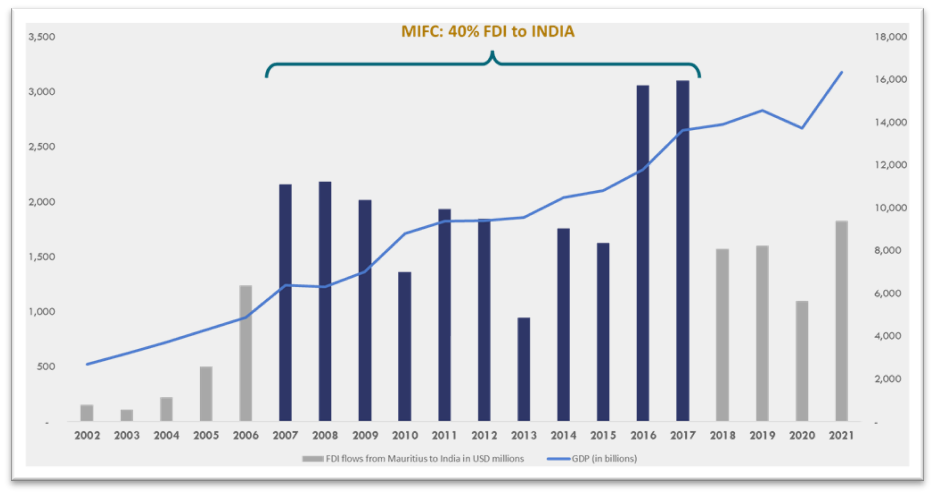
As illustrated by the graph above, it can be observed that during the period 2002 to 2022, a cumulative value of around USD 155 billion worth of investments has been structured to India through the Mauritius IFC.
The Mauritius IFC has thus been fundamental to India's rise as a global economic superpower and towards soon becoming the third largest economy by 2027-2028. It is noteworthy that India’s GDP is forecasted to reach USD 30-35 trillion by 2047, and that the Mauritius IFC aims to keep playing a pivotal role towards India’s economic growth.
3. Mauritius – An IFC of Choice for Africa
Today, Africa is considered as having one of the fastest growing demographics in the world. Some analysts believe that Africa will bolster global economic growth as the new emerging markets investment frontier.
Over the years, the Mauritius IFC remains a trusted, leading and tested IFC, facilitating cross-border investments into the African continent. A total value of USD 82 billion of investments have successfully been structured across Africa, generating USD 6 billion in annual tax revenues for several African States.
Just like for India, this demonstrates that the Mauritius IFC could again play a significant role to the economic growth and prosperity of the Continent.
4. Mauritius IFC pledge to the OAU
The African continent is no doubt the most resource-abundant continent, with over 30% of the world's mineral reserves. Yet, Africa has the lowest GDP per capita income representing only 3% of the world’s income. However, Africa’s GDP has the potential to increase from USD 2 trillion to USD 29 trillion by 2060.
As global investors seek high returns on investment, the Mauritius IFC could well play an important role in de-risking African investments and make the continent more attractive and investor friendly. To that end, on top of Mauritius positioning itself as a leader in Africa in the World Bank's Ease of Doing Business Index, the Global Innovation Index, the Mo Ibrahim Index of African Governance, and the Heritage Foundation's Index of Economic Freedom, the Mauritius IFC has further exceeded expectations by being largely compliant or compliant to all the 40 recommendations of the FATF, including Recommendation 15 which requires that Virtual Assets (VAs) and Virtual Asset Service Providers (VASPs) be regulated for anti-money laundering and countering the financing of terrorism (AML/CFT) purposes.
Mauritius is amongst the first countries in the Eastern and Southern African region which has adopted a comprehensive legislation on Virtual Assets and Initial Token Offerings compliant to the FATF and the AML/CFT regimes. This framework enables the regulation of transfer of virtual assets and fiat currencies, exchange between virtual assets and fiat currencies, safekeeping as well as administration of virtual assets.
Furthermore, one of the latest additions to the list of fund structures being promoted by the Mauritius IFC is the Variable Capital Company (VCC), which provides a framework for funds to carry out business through one or more sub-funds or Special Purpose Vehicles (SPVs), all within one structure.
Some of the major projects under development by the Mauritius IFC are as follows:
- A harmonized Environmental Social and Corporate Governance (ESG) framework is currently being developed to be promoted in the global investment value chain.
- Endowed with a welcoming hybrid legal framework (a blend of both the French civil law and the British common law practices), Mauritius is aiming to become a seat of international arbitration, through its Permanent Court of Arbitration, already in operation.
- The Mauritius IFC is also looking into introducing the provision of funding or capital for the acquisition or use of movable assets, including aircrafts and shipping vessels. This type of funding structure will provide businesses with the flexibility to acquire or utilize assets without the need for upfront capital outlay.
These new lines of services further add substance to, and strongly position the Mauritius IFC as an enabler towards the absorption of capital and technology across the African continent.
5. Africa Centre of Excellence (ACE)
The experience and expertise gained over the past three decades in setting up the Mauritius IFC which adheres to all global standards and requirements set by international bodies, are being pledged in making investment in Africa more attractive and less risky.
One of the key initiatives of the Economic Development Board (EDB) in supporting the economic rise of Africa is the launch of the Africa Centre of Excellence (ACE), with the following objectives:
- Create empowered, efficient and successful Investment Promotion Agencies (IPAs) in Africa
- Enhance dialogue and cooperation with stakeholders in Africa;
- Experience exchange and capacity building programme within the region;
- Host & organize cooperation programmes and world class training for Investment Promotion Agencies (IPAs);
- Improve business climate and encourage reforms;
- Provide consultancy services for specific projects;
- Host inward technical missions; and, amongst others,
- Assist in policy advocacy.
6. Africa Partnership Conference
In order to further integrate identified investment opportunities and ensure visibility and attractiveness of projects, with the lowest risks and highest returns on investment, the EDB shall host its flagship Africa Partnership Conference (APC) on the 2nd and 3rd of October 2023.
The EDB intends to invite some 20 Investment Promotion Agencies from across Africa, along with collaborating with global organisations, Development Finance Institutions (DFIs) and other countries to plan, coordinate and host a two-day conference with the objective to promote trade and investment across the African continent.


