
EDB Monthly Newsletter
Your Monthly Pulse on Investment, Innovation & Growth.

Mauritius welcomes investment and embraces business. Globally recognised as a safe, stable and easy environment to conduct business, Mauritius is a great place to invest, work, live and retire, with future ready infrastructure, global connectivity and world class talent.
Invest in a project of at least Rs 500 million and take advantage of incentives, rebates, exemptions and preferential rates.
Leverage on our unparallel preferential market access to 68% of the world’s population and benefits from a panoply of Free Trade Agreements.
Mauritius’ residence program allows foreign nationals to make a real estate investment into the country and apply for a residence permit to live, work, and retire in Mauritius.
Live and work remotely from Mauritius and experience a long stay or retire in a picture-perfect tropical paradise.
Leverage on our unparallel preferential market access to 68% of the world’s population and benefits from a panoply of Free Trade Agreements.
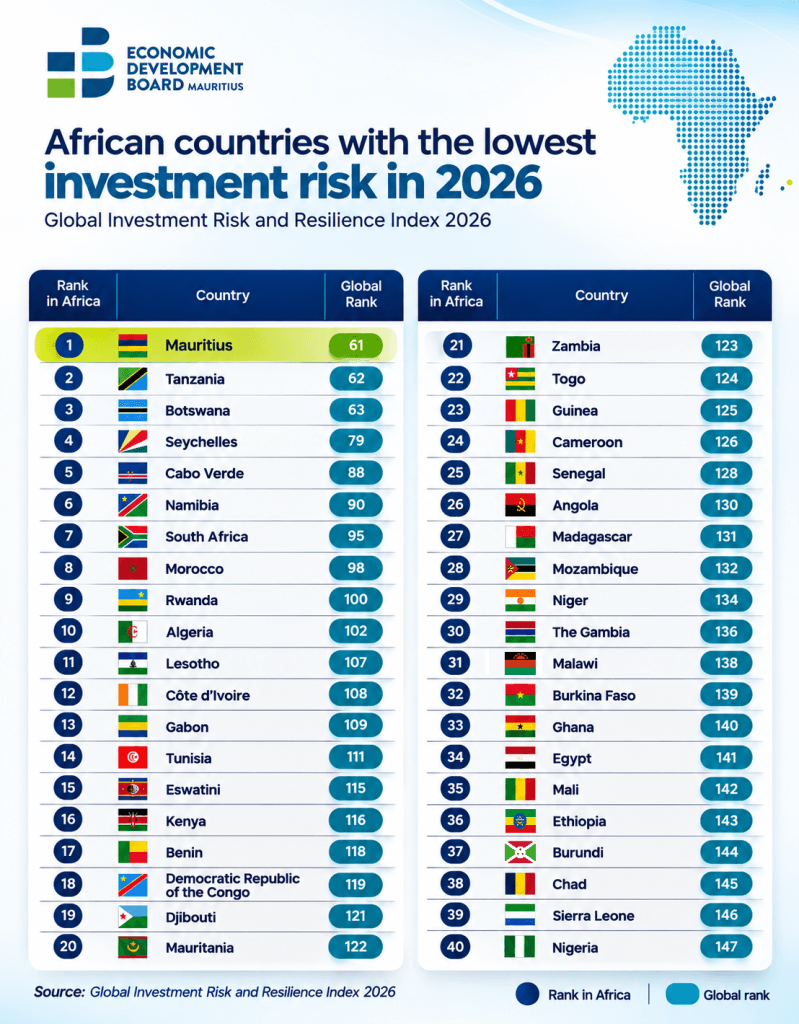
Mauritius has emerged as Africa’s leading jurisdiction for investment risk and resilience, ranking 61st globally with an overall score of 62.20 in the 2026 Global Investment Risk and Resilience Index (GIRRI), published by Henley & Partners in partnership with AlphaGeo.
The ranking places Mauritius ahead of Tanzania (62nd globally), Botswana (63rd), Seychelles (79th) and Cabo Verde (88th), reinforcing the island’s position as the continent’s strongest performer in an increasingly complex global investment environment.
The May 2026 special edition stress-tests the index against recent geopolitical shocks by combining long-term structural resilience with real-time market signals, including Country Risk Premium data as of 1 April 2026.

Mauritius’ performance reflects a relatively low exposure to key sources of investment risk. The country records a Total Risk Score of 26.47 out of 100, with lower scores indicating lower risk. Its risk indicators include particularly low Currency Volatility (0.06) and Political Instability (0.22), alongside Inflation Risk (0.25) and Legal and Regulatory Risk (0.26). While Physical Climate Risk (0.53) remains a comparatively higher exposure, the overall profile demonstrates Mauritius’ ability to provide investors with a stable and predictable operating environment.
This positioning is particularly significant at a time when geopolitical and economic shocks are prompting investors to reassess country risk and reposition capital across jurisdictions.
The country’s standing is further supported by a Total Resilience Score of 50.87 out of 100, with strong scores in Social Progress (0.64) and Quality of Governance (0.63), as well as Fiscal Policy Space (0.54) and Climate Resilience (0.53). Mauritius also records scores of 0.48 for Innovation, 0.44 for External Accounts, and 0.41 for both Economic Complexity and Investment. Taken together, these indicators highlight the combination of institutional, social, economic and environmental characteristics underpinning Mauritius’ resilience.
In a global landscape where investors are increasingly assessing jurisdictions not only by their exposure to risk but also by their capacity to absorb and navigate shocks, Mauritius’ first-place ranking in Africa strengthens its proposition as a trusted, resilient and future-ready investment hub.

