


28 Sep 2026 • Economic Development
Consolidating Economic Linkages between Mauritius & Tunisia
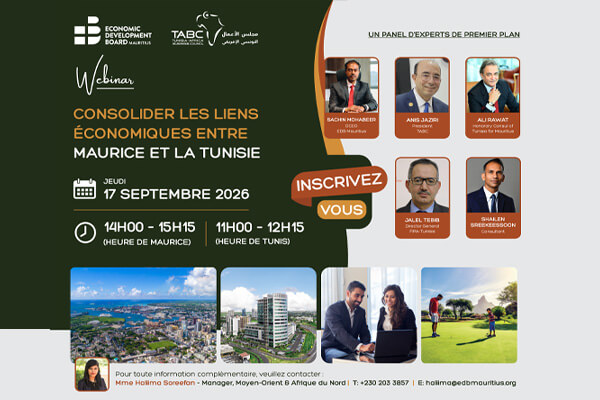
The Economic Development Board (EDB) Mauritius, in collaboration with the Tunisia-Africa Business Council (TABC), hosted a webinar themed “Consolidating Economic Linkages between Mauritius & Tunisia” on Thursday, 17 September 2026, bringing together more than 75 participants, including over 65 participants from Tunisia, representing a diverse range of sectors.
The strong participation reflected significant interest from the Tunisian business community in Mauritius as an investment and business platform, as well as in opportunities for partnerships and expansion into African markets. The webinar provided a valuable platform for businesses and institutions from both countries to exchange perspectives, explore areas of mutual interest and identify opportunities for deeper economic cooperation.
The event also strengthened engagement with key Tunisian stakeholders, notably the Tunisia-Africa Business Council (TABC) and FIPA-Tunisia, while highlighting Mauritius’ positioning as a strategic gateway to Africa. Discussions explored potential areas of collaboration across financial services, pharmaceuticals, healthcare, agro-processing, tourism, logistics, ICT and trade.
Building Bridges Between Mauritius and Tunisia
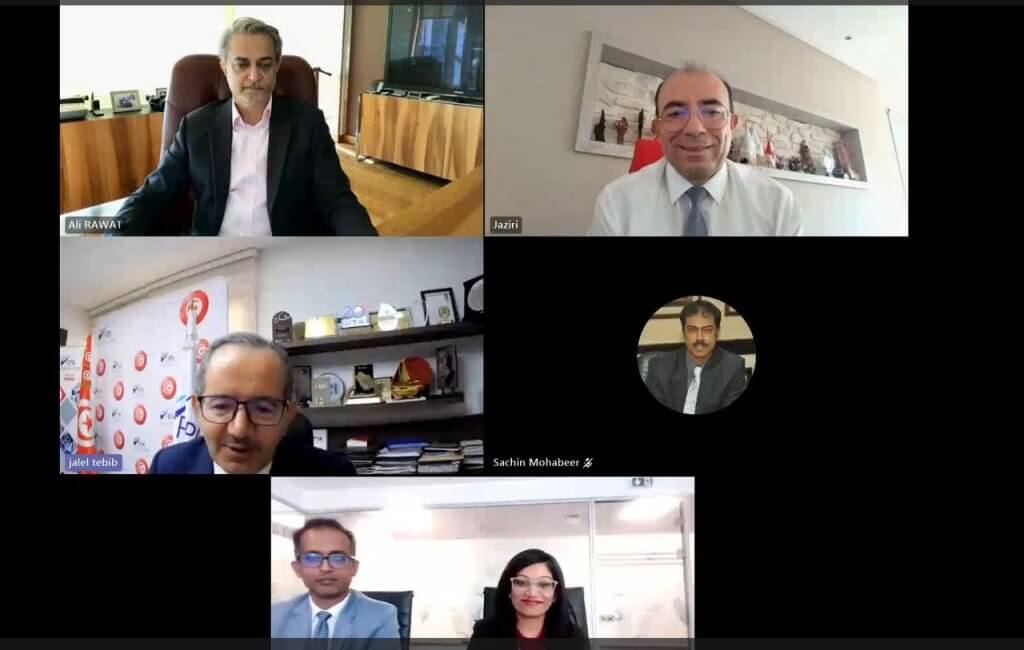
H.E. Ali Rawat, Honorary Consul of Tunisia in Mauritius, described the shifting global economy as both a challenge for businesses unable to adapt and an opportunity for those ready to innovate and explore new markets. He stressed his role in strengthening Mauritius–Tunisia economic ties by connecting companies with the right institutions, facilitating introductions and supporting them throughout their expansion, with the aim of turning promising opportunities into concrete projects and successful business outcomes.
Strengthening Tunisian Business Expansion into Africa
Mr. Anis Jaziri, President of TABC, outlined the Council’s role in supporting Tunisian investors and businesses seeking to expand across Africa by identifying opportunities, facilitating market access and accompanying their international development. He welcomed a structured partnership with Mauritius to deepen trade, investment and cooperation between the two business communities.
He highlighted Mauritius’ attractive business environment, established financial centre and strategic access to COMESA and the African Continental Free Trade Area, supported by the Double Taxation Avoidance Agreement between Mauritius and Tunisia. Mr. Jaziri expressed the hope that these advantages would encourage Tunisian companies to establish a presence in Mauritius and use the island as a platform for wider expansion into African markets.

Mauritius and Tunisia: Complementary Strengths, Shared Opportunities
Mr. Sachin Mohabeer, Deputy Chief Executive Officer of the EDB, delivered a comprehensive presentation on Mauritius, highlighting the strong complementarities between the two countries and the opportunity to build a genuine regional partnership.
He emphasized that Mauritius and Tunisia have much in common, while each brings distinct strengths and capabilities to the table. Tunisia has a solid industrial base, technological capabilities, skilled human capital and a strategic position as a gateway to Europe and the Maghreb. Mauritius, meanwhile, offers a stable, resilient and open economy, a diversified economic base, a secure investment environment and strategic access to markets in Eastern and Southern Africa.
Mr. Mohabeer stressed that for Tunisian companies, the question is not about choosing between Tunisia and Mauritius, but rather how to leverage the complementary strengths of both countries. By combining Tunisia’s industrial capabilities, technology, expertise and proximity to Europe and the Maghreb with Mauritius’ connectivity, investment ecosystem and access to African markets, businesses can create greater value and develop new regional opportunities.
He presented Mauritius as a potential strategic platform and regional multiplier for Tunisian companies seeking to expand their activities into Africa. Its strategic location, international connectivity and access to regional markets can provide companies with a platform from which to establish and scale their African operations.
Mr. Mohabeer also highlighted Mauritius’ stable and resilient economic environment, supported by a diversified economy, a population of approximately 1.2 million, strong institutions, a robust democratic system and a secure investment environment. Its transparent and predictable business framework, internationally aligned standards, modern infrastructure, skilled talent and mature investment ecosystem further strengthen its position as a platform for international businesses.
The presentation highlighted the potential to move beyond a traditional bilateral relationship and build a genuine regional platform connecting North Africa, Europe, Eastern Africa and Southern Africa. In this model, Tunisia can serve as a gateway to Europe and the Maghreb, while Mauritius can provide a strategic bridge to markets across Eastern and Southern Africa.

FIPA-Tunisia Highlights Sectoral Opportunities
Mr. Jalel Tebib, Director General of FIPA-Tunisia, provided an overview of Tunisia’s investment environment and highlighted the country’s strategic advantages as an investment destination and business hub.
He noted the existing people-to-people links between the two countries, including the presence of more than 60 Tunisians in Mauritius, while underlining the potential to further develop economic and investment relations.
Mr. Tebib highlighted Tunisia’s attractive business climate, strategic geographic position, skilled human capital and diversified economy. He noted that the country’s industrial sector continues to attract significant investment, while its services sector has also developed considerably, creating opportunities across a broad range of activities.
Particular attention was given to ICT and financial services, where both Mauritius and Tunisia have developed important capabilities and where there is potential for greater cooperation, investment partnerships and exchange of expertise.
He stressed that the similarities and complementarities between the two economies provide a strong basis for increased investment flows, business partnerships and new avenues for collaboration.
From Dialogue to Concrete Opportunities
The webinar supported ongoing efforts to translate Mauritius–Tunisia dialogue into practical economic cooperation, highlighting how Tunisia’s industrial capabilities, technology, skilled workforce and links to Europe and the Maghreb can complement Mauritius’ stable business environment, financial ecosystem, international connectivity and access to Eastern and Southern Africa. It also provided a basis for further collaboration, with the EDB, TABC and their Tunisian partners supporting business matching and exploring trade, investment and regional expansion opportunities.
Review the webinar
Share this article
Latest News
1
Consolidating Economic Linkages between Mauritius & Tunisia
28 Sep 2026 •Economic Development
2
25 Sep 2026 •Economic Development
3
Strengthening the EU–Mauritius business and investment partnership
25 Sep 2026 •Diplomacy
4
Workshop: “Driving Export Growth in Industry through Digital Transformation, E-Marketing and AI”
18 Sep 2026 •Artificial Intelligence • Manufacturing Industry
5
Notice to exporters – Export Incentives Schemes Financial Year 2026-2027
10 Sep 2026 •Economic Development


