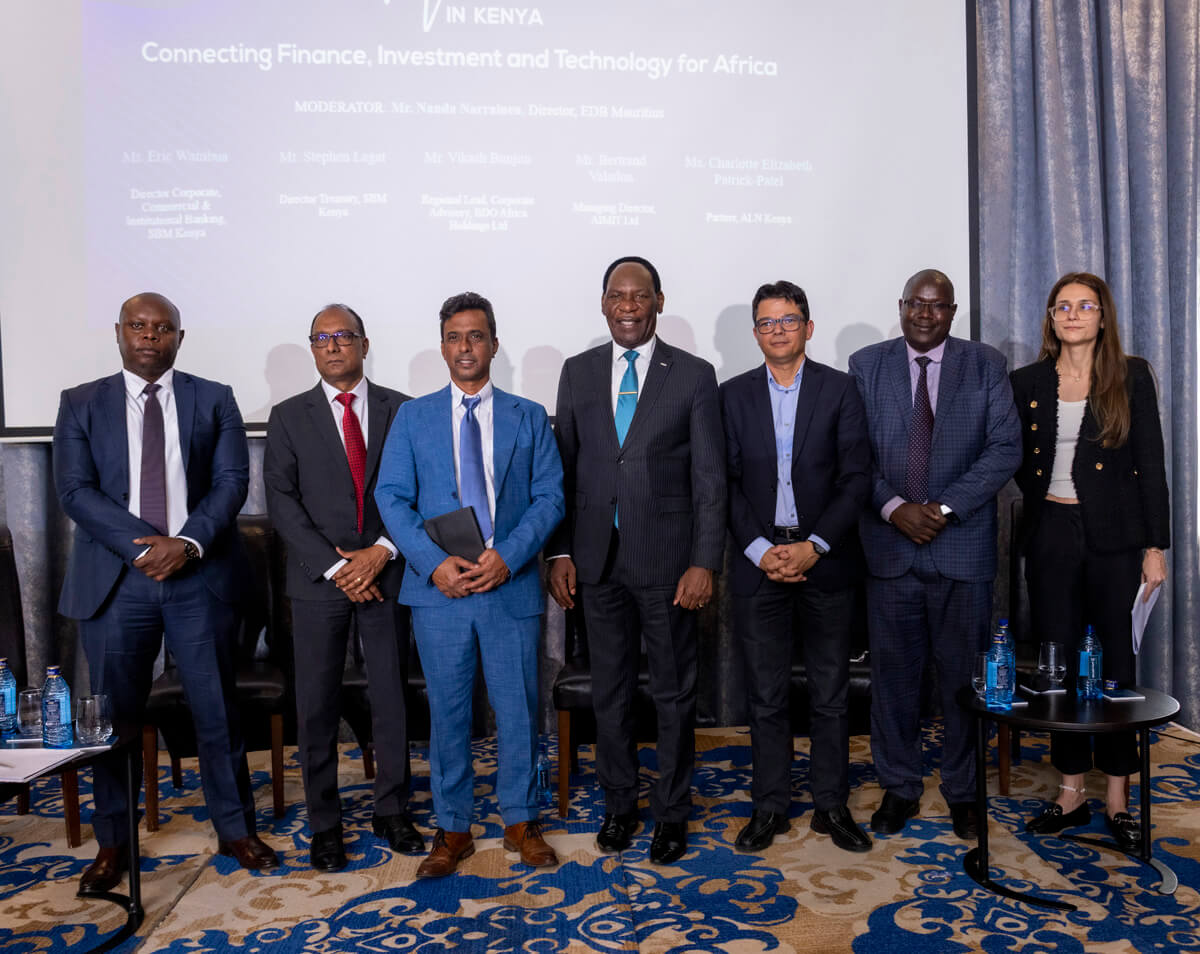
EDB Strengthens Mauritius–Kenya Links, Unlocking Opportunities in Education, Financial Services and Technology

16 Oct 2026
Maurice accueille les investissements et encourage les affaires. Reconnue mondialement comme un environnement sûr, stable et propice aux activités commerciales, Maurice est un excellent endroit pour investir, travailler, vivre et prendre sa retraite, avec des infrastructures tournées vers l'avenir, une connectivité mondiale et des talents de classe internationale.
Investissez dans un projet d'au moins 500 millions de roupies et bénéficiez d'incitations, de remises, d'exonérations et de taux préférentiels.
Profitez d’un accès préférentiel inégalé à 68 % de la population mondiale grâce à un vaste réseau d’accords de libre-échange.
Maurice, la plateforme idéale pour les affaires et l'investissement en Afrique
Opportunités de marché
Opportunités de marché Accords bilatéraux Réformes facilitant les affaires Outils d'analyse de marchéLe programme de résidence de Maurice permet aux ressortissants étrangers d'effectuer un investissement immobilier dans le pays et de demander un permis de résidence pour vivre, travailler et prendre leur retraite à Maurice.
Vivez et travaillez à distance depuis Maurice et profitez d'un long séjour ou prenez votre retraite dans un paradis tropical idyllique.
Profitez d’un accès préférentiel inégalé à 68 % de la population mondiale grâce à un vaste réseau d’accords de libre-échange.
Maurice, la plateforme idéale pour les affaires et l'investissement en Afrique
Autres liens utiles
Actualités Événements Communiqué de Presse Appels d’offres Témoignages Centre d'Information Vacancy
RT Knits is among the pioneers in the region to integrate Artificial Intelligence into apparel manufacturing. In this conversation, its CEO reflects candidly on what AI has and has not changed on the factory floor, where the real returns lie, and what it will take for Mauritius to compete as an innovation-driven manufacturing hub rather than simply a user of tools built elsewhere.
RT Knits was at the forefront of AI adoption in the textile industry. What was the specific problem that pushed you to start — and looking back, what did you get wrong early about where AI would actually help?
There was never a single moment of conversion. The pressure has always been the same, and it is permanent: increase productivity, reduce mistakes, and shorten the lead time from a customer’s request to execution. AI simply became the most powerful tool we had found for a very old problem.
It helps to be precise about where human effort actually goes in a business like ours. There are two kinds of work: the manual work done by operators on the floor, and the intellectual work done by everyone sitting at a computer. We treat both as things to be continuously improved. For the manual side, that has meant sustained investment in automated and increasingly specialised production equipment. For the intellectual side, it meant committing early to digitalisation — and choosing to build our own tools rather than buy them off the shelf.
RT Knits is among the pioneers in the region to integrate Artificial Intelligence into apparel manufacturing. In this conversation, its CEO reflects candidly on what AI has and has not changed on the factory floor, where the real returns lie, and what it will take for Mauritius to compete as an innovation-driven manufacturing hub rather than simply a user of tools built elsewhere.
We began our AI journey in 2017, with a small team. In those early years, honestly, there were many proofs of concept and very few ideas we could implement at a scale that created real value for the company. Nothing went wrong, but it would be misleading to call it a period of quick wins. It was a learning and investment phase — and it was worth it, because the capability we built then is what let us move quickly later.
The decision to own that capability rather than rent it was deliberate, and for several reasons. Textile is one of the least standardised industries there is, so digitalisation genuinely requires customised solutions — the off-the-shelf product is usually built for a standardised process we don’t have. We also believe proprietary solutions are a source of competitive edge in themselves: if everyone buys the same tool, no one is differentiated by it. Owning the capability makes us more agile, so that technology serves our main revenue-generating processes rather than the other way round. It means the improvement roadmap is ours to set — we prioritise by our own economics, not a vendor’s release schedule. The data our processes generate stays with us and compounds over time, which is itself a growing asset. And building rather than buying develops real capability inside the company — people who understand both the technology and the manufacturing, which is a rare and valuable combination.
If there is a lesson in all of this, it is about scale rather than error. The arrival of generative and agentic AI did not merely add another tool — it inverted the constraint. For years the limiting factor had been our ability to find solutions. Almost overnight, the limiting factor became our capacity to implement them. The list of good ideas now grows faster than any organisation can execute, and learning to manage that abundance has become a discipline in its own right.
RT Knits was at the forefront of AI adoption in the textile industry. What was the specific problem that pushed you to start — and looking back, what did you get wrong early about where AI would actually help?
There was never a single moment of conversion. The pressure has always been the same, and it is permanent: increase productivity, reduce mistakes, and shorten the lead time from a customer’s request to execution. AI simply became the most powerful tool we had found for a very old problem.
It helps to be precise about where human effort actually goes in a business like ours. There are two kinds of work: the manual work done by operators on the floor, and the intellectual work done by everyone sitting at a computer. We treat both as things to be continuously improved. For the manual side, that has meant sustained investment in automated and increasingly specialised production equipment. For the intellectual side, it meant committing early to digitalisation — and choosing to build our own tools rather than buy them off the shelf.
We began our AI journey in 2017, with a small team. In those early years, honestly, there were many proofs of concept and very few ideas we could implement at a scale that created real value for the company. Nothing went wrong, but it would be misleading to call it a period of quick wins. It was a learning and investment phase — and it was worth it, because the capability we built then is what let us move quickly later.
The decision to own that capability rather than rent it was deliberate, and for several reasons. Textile is one of the least standardised industries there is, so digitalisation genuinely requires customised solutions — the off-the-shelf product is usually built for a standardised process we don’t have. We also believe proprietary solutions are a source of competitive edge in themselves: if everyone buys the same tool, no one is differentiated by it. Owning the capability makes us more agile, so that technology serves our main revenue-generating processes rather than the other way round. It means the improvement roadmap is ours to set — we prioritise by our own economics, not a vendor’s release schedule. The data our processes generate stays with us and compounds over time, which is itself a growing asset. And building rather than buying develops real capability inside the company — people who understand both the technology and the manufacturing, which is a rare and valuable combination.
If there is a lesson in all of this, it is about scale rather than error. The arrival of generative and agentic AI did not merely add another tool — it inverted the constraint. For years the limiting factor had been our ability to find solutions. Almost overnight, the limiting factor became our capacity to implement them. The list of good ideas now grows faster than any organisation can execute, and learning to manage that abundance has become a discipline in its own right.
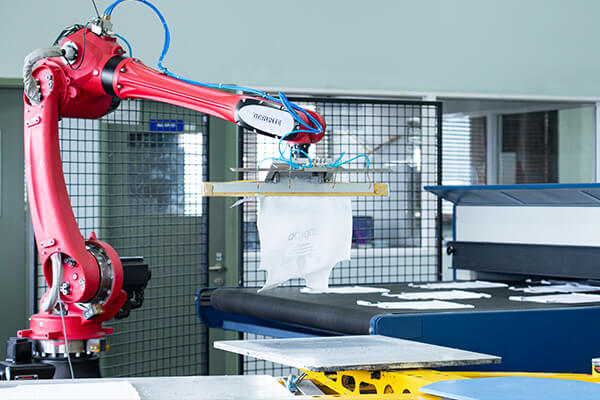
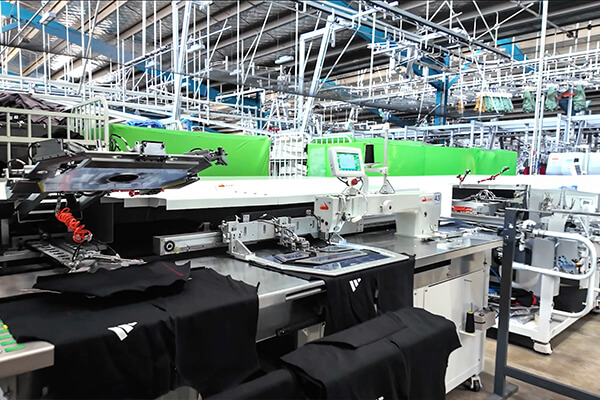
Apparel is a physical business — fabric still has to be cut, sewn and finished by people. Where has AI genuinely changed how RT Knits operates, and where has it made almost no difference to the factory floor despite the hype?
Let me start by correcting an assumption that shapes how most people think about this industry. We tend to believe the major cost in making a garment is manual labour. In our experience that is not true — the cost of intellectual work, carried out by everyone working at a computer, is higher than the cost of the manual work on the floor. Once you see that clearly, it changes where you look for the biggest gains.
That is exactly where AI has changed us most. Generative and agentic AI has let our developer team build solutions far faster than before. More significantly, agentic AI can now process almost any form of unstructured information — and in our industry almost everything is unstructured. Every customer’s tech pack is different from the next. Emails carry critical instructions in no fixed format. Even customer specifications follow no common standard from one account to another. Handling that variety used to be slow, manual intellectual work; increasingly it is not. That is where the real transformation has happened, and it is largely invisible to anyone standing on the factory floor.
On the floor, the picture is more mixed. One clear success is in fabric production. Our fabric is knitted on circular machines, and there it was relatively straightforward to fix a camera in place and capture a continuous stream of images to detect broken needles or holes that need an immediate fix. The fabric moves past a fixed point, so the vision system can do its job without any complex handling.
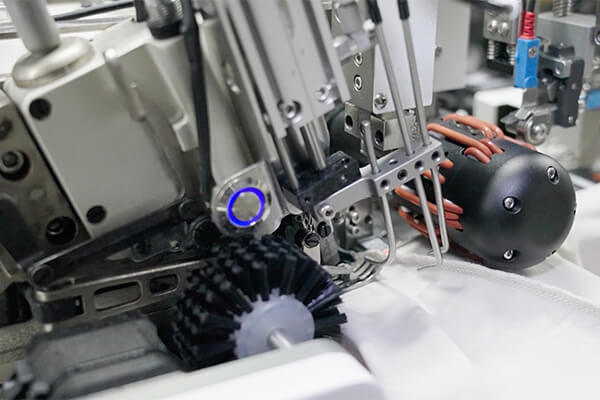
Final quality inspection is where the hype has met a harder reality. We had high hopes that vision AI would let us automate much of the inspection still done by hand. It has proved more complicated than we expected. Quality checking is not just looking at a garment — it means opening the seams, turning it over, inspecting the reverse side. So we need not only a very large set of images to train the algorithm, but also a physical system capable of manipulating the garment the way a person does. And with the sheer variety of garments we produce, engineering a solution that is both reliable and cost-effective is genuinely difficult.
The contrast between those two cases is the real lesson. Where the material presents itself to the camera, vision AI works well today. Where something must be physically manipulated to be inspected, the intelligence is nearly ready but the handling is not — and in a physical business, that distinction is where much of the opportunity, and the difficulty, still lies.
Beyond the pilots and proofs of concept, where has AI actually paid for itself — and where has the return been slower or smaller than you expected?
As I said earlier, we treat pilots and proofs of concept as necessary investments rather than as failures when they don’t scale — that is simply the cost of learning in a field moving this quickly. On the whole, most of the investments we have made in AI have paid for themselves.
There are exceptions, and it is worth being honest about one. We invested in a powerful server — 512 GB of unified memory — in the hope of hosting a capable open-source language model locally, within our own infrastructure. In practice it was too slow, and the open-source models good enough for our needs are simply too large to run well on it. It was a reasonable bet at the time, and one many companies are weighing right now, but the return did not materialise the way we hoped. The economics and the pace of the technology are moving quickly enough that the sensible answer to “build it in-house or use it as a service” keeps changing.
The more forward-looking part of the question is what we are deliberately doing now. Our focus has shifted from building individual solutions to building reusable systems — tools and components we can apply again and again across different problems. That choice comes with a real trade-off. It makes us slower today, because building something reusable takes more effort than building something for a single use. We are consciously accepting a slower return in the short term in exchange for compounding speed later: each reusable system we build should make the next set of solutions faster and cheaper to develop. For us that is the right trade, because in a permanent improvement journey, the speed at which you can build the next thing eventually matters more than the speed of any single project.
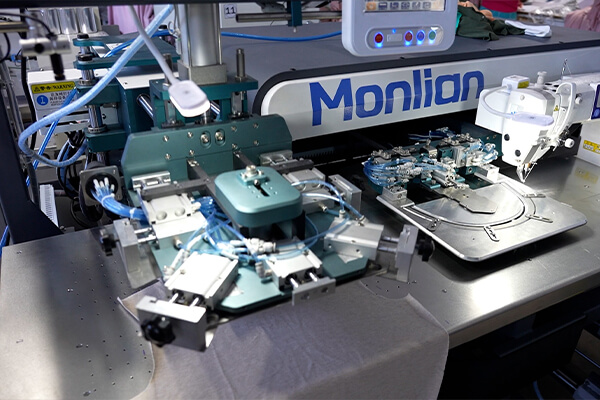


Apparel manufacturing has always chased the lowest labour cost. If AI and automation weaken the link between competitiveness and cheap labour, does that open a door for a mid-cost, high-trust destination like Mauritius — or does it hand an even bigger advantage to the mega-factories that can automate at scale?
I am less worried about the mega-factory than this question assumes, for two reasons.
The first is that factory and customer have to be matched in size. A mega-factory is built to serve very large retailers placing very large orders; it is not designed to work with the kind of brands we serve, and it serves them poorly when it tries. Scale is not a universal advantage — it is an advantage only against a particular kind of demand. So the arrival of automation does not simply hand the game to the biggest player, because the biggest players are not competing for the same customers we are.
The second reason matters more. If AI weakens the old link between competitiveness and cheap labour, then competitiveness increasingly comes down to the speed at which a company can improve itself — how quickly it can identify a problem, build a solution, and put it into production. Here, being smaller is an advantage, not a handicap. We are more agile. We can iterate faster, implement faster, and change direction faster than a very large organisation can. In a world where the technology itself keeps moving, the ability to adopt and adapt quickly is worth more than sheer size.
This is where Mauritius has something specific to offer, beyond simply being mid-sized. Our destination is built on trust — reliability, ethical production, and the kind of long-term relationships premium brands depend on — and on genuine sustainability credentials that are increasingly a purchasing criterion rather than a nicety. The old model rewarded the lowest cost per hour. The emerging model rewards trust, responsiveness, sustainability, and the speed of improvement. Those happen to be precisely the things a mid-sized, high-capability, premium-oriented manufacturer in Mauritius can be very good at.
I would add one honest caveat. This door opens for Mauritius, but it does not stay open on its own. If competitiveness now turns on the speed of improvement, then we only win if our firms actually move fast on AI — not just talk about it. The opportunity is real, but it is conditional, and the condition is our own pace of adoption.
A manufacturer can do all the hard AI work — better planning, fewer defects, faster development — and still watch the value captured downstream by the brand. How do you make sure the gains land on the manufacturer’s side of the chain, rather than simply becoming the customer’s new baseline expectation?
This is one of the most important questions in our industry, and the honest starting point is that the whole chain has been relentlessly chasing lower prices for decades.
Let me deal first with a common misconception. The manufactured product represents somewhere between 5% of the final retail price for a premium brand and perhaps 30% for a more cost-driven one. Looking at that, most people conclude that the brand captures nearly all the value. But that isn’t what the evidence shows. When you actually read the financial statements of the retailers, many of them are not particularly profitable — a large share are either struggling or delivering erratic performance. The value is not sitting comfortably downstream; a great deal of it is being competed away. And when a retailer starts to lose money, the pressure travels straight back up the chain to the manufacturer to cut prices.
The value we offer is built around all of these: reliability, quality, and being a manufacturer a brand can trust completely with its name.
So the question of how the manufacturer captures value cannot be answered by trying to win on price. Every retailer cross-costs the same style across several suppliers; there is always someone willing to quote lower. Our approach is different. We do not need to match the retailer’s target price. We need to be the supplier that offers them the most total value — and price is only one component of that.
Total value includes everything the purchase price ignores. What is the real cost to the brand if the product is delivered late and misses its window on the shelf? What is the cost of quality problems discovered after delivery? And what would it cost the brand’s reputation if the media uncovered a scandal at the factory making its garments? These are not soft considerations — for a brand, they are existential, and they dwarf a few percentage points on unit price. The value we offer is built around all of these: reliability, quality, and being a manufacturer a brand can trust completely with its name.
There is a second perspective worth adding, because the size of that price gap tells you something. A gross margin that large is not purely brand value — a good part of it is inefficiency in the chain between the factory and the shelf. In the last few years that inefficiency has opened the door to a genuinely disruptive model, which I would call Manufacturer-to-Consumer: products made in developing countries and shipped directly to the end consumer, bypassing most of the traditional chain. In roughly five years, players built on this model have captured a very significant share of the clothing market. I do not hold them up as a template — they compete at the low-cost, high-volume end, on very different terms from ours, and on the labour and environmental questions the industry rightly scrutinises. But the lesson is unavoidable: the value trapped in the middle of the chain was real, and large enough that someone came to take it. The strategic question for a manufacturer like us is not whether to copy that model, but how to capture more of that trapped value on our own terms — through trust, sustainability, and direct, durable relationships rather than through price and volume alone.
That is how the gains stay on our side of the chain. If you compete only on price, any improvement you make is immediately handed to the customer as a lower quote. If you compete on total value, the improvements you make through AI — better on-time delivery, fewer defects, faster development — become reasons the customer needs you specifically. The value is captured in the relationship, not surrendered in the next negotiation.
As AI spreads, does it widen or narrow the gap between the best manufacturers and the rest? Is this an advantage the leaders can defend, or does it commoditise quickly once everyone has the same tools?
The gap between the best manufacturers and the rest has never come from a single source of advantage, and it will not in the future either. The best are better in a holistic way — across innovative products, quality, reliability against a committed delivery date, consistency, responsible and transparent production, excellent customer service, short lead times, a genuine ability to solve the customer’s problems, and, of course, competitive prices. No one of these wins on its own; it is the combination, sustained over time, that separates the leaders.
AI will certainly improve several of these areas. But it is worth being clear about what AI actually is: it is a tool that helps a company build better tools, faster. It is an accelerator. And an accelerator only takes you somewhere useful if you are pointed in the right direction. If the underlying strategy is wrong, AI will simply help you get to the wrong place more quickly.
That is why I don’t believe the advantage commoditises the way the question suggests it might. Everyone will eventually have access to the same underlying AI — just as everyone already has access to the same sewing machines. The tools become common; what does not become common is the judgement about where to apply them, the quality of the processes they are applied to, and the discipline to keep improving across all those dimensions at once. Two companies with identical tools and different strategies will get very different results. So AI widens the gap rather than narrowing it — not because the leaders hold a secret technology, but because they are better at turning any given tool into advantage.
AI is an accelerator. And an accelerator only takes you somewhere useful if you are pointed in the right direction.
Sustainability and efficiency usually point the same way — but not always. Where does AI genuinely cut waste and energy for you, and where does the pursuit of efficiency start to pull against other goals, like employment?
Cutting waste and energy is, at its core, an engineering problem, and we have always treated it as one — continuously improving our efficiency in these areas over many years. I come from an engineering background myself, so this has always had my attention. There is still a great deal to improve, but I believe we are already well ahead of the industry average.
AI has become a genuine part of that engineering work. Our engineering team uses language models as a brainstorming partner and as a way to assess ideas quickly — testing an approach in minutes rather than days, across many areas of their day-to-day work. It does not replace engineering judgement, but it accelerates the cycle of proposing and evaluating improvements, which is where a lot of efficiency gains come from.
The more delicate part of your question is employment, and here I want to be direct, because it is where efficiency and other goals are assumed to collide. We are far more productive than we were ten years ago, thanks to automation on both the production side and in data processing. And yet we have never reduced our workforce because we automated a process. That is a deliberate choice. We use the efficiency we gain to increase our output and grow, rather than to shrink. Automation tends to deskill work — it makes a given operation simpler — which means an operator whose task is automated can be retrained for another operation relatively easily. Growth is what makes that possible: as long as the company is expanding, improved efficiency creates capacity for more work rather than fewer people.
I would be honest that this depends on continuing to grow. Efficiency without growth would eventually force the harder trade-off. So for us the two goals do not conflict — but only because we have kept growing, and keeping the company growing is therefore not just a commercial objective, it is what allows us to modernise without displacing our people.
You argue AI transformation has to start at the top. What can a CEO see or decide about AI that a CTO or a consultant can’t — and what’s the failure mode when leadership treats it as an IT project to delegate?
AI transformation has to start at the top for a simple reason: AI is not really a technology decision, it is a strategy decision that happens to involve technology. A CTO can tell you what is technically possible. A consultant can tell you what other companies are doing. But only the CEO can decide what the company is fundamentally trying to become — and AI is far too consequential to be applied to anything other than that.
There is a specific reason the CEO’s vantage point matters. As I said earlier, AI is an accelerator: it helps you get where you are going faster. That makes the choice of direction more important than ever, not less. Deciding where to point that acceleration — which processes matter most, which parts of the business are worth transforming, what the company should look like in five years — is precisely the work that cannot be delegated, because no one else in the organisation sees the whole board. A CTO optimises the system they are given. Only the CEO can decide whether it is the right system in the first place.
The failure mode is exactly what the question describes: treating AI as an IT project to be handed down. When that happens, a few things go wrong. The initiative gets scoped as a series of technical implementations rather than a rethinking of how the business works, so it produces isolated tools instead of transformation. It gets measured on delivery rather than on impact. And because no one with real authority owns it, it stalls the moment it needs a difficult decision — a change to a core process, a reallocation of budget, a shift that crosses departmental lines. Technology projects can be delegated. Deciding what the company is becoming cannot.
This is also why I believe leaders themselves have to understand AI — not at the level of writing code, but well enough to have genuine judgement about what it can and cannot do. A CEO who does not understand the tool cannot tell an over-promise from a real opportunity, cannot challenge their own team meaningfully, and ends up either dismissing AI or believing everything they are told about it. Neither is leadership. You do not need to be an engineer, but you do need to have done enough of the thinking yourself to hold an informed view.
AI will change what your people do. Which roles become more valuable, which get hollowed out, and how do you handle the honest tension between automating work and being a significant employer in your community?
This is something we are very conscious of, and we think about it in terms of three levels of work.
The first level is execution — jobs that mainly follow a defined procedure and do not require analysis or judgement. These are the roles most exposed to automation, because following a fixed procedure is precisely what machines and AI do well. The second level is the work of synthesising information, analysing it, and deciding. This work will remain human-led, but increasingly assisted by AI — the person stays in charge of the judgement, while the tool handles the gathering and the first pass. The third level is leadership: setting direction, taking responsibility, deciding what matters. This remains firmly human, and I do not expect that to change.
The roles that become more valuable, then, are the ones higher up that ladder — anyone whose work involves genuine analysis, judgement, and the ability to lead. The roles most exposed are the purely executional ones. But I want to be clear about how we treat that, because the answer is not simply to remove those jobs and the people in them.
On the factory floor, as we automate manual work, that work becomes deskilled — simpler to learn. Rather than a threat, we have made this a source of flexibility: most of our operators are now polyvalent, able to move between and operate several different types of equipment. That makes the whole operation more adaptable, and because we are growing, it has never meant a reduction in our workforce. The efficiency we gain creates capacity for more output, not fewer people.
For our intellectual workers, we have already begun equipping them to move up a level. All of our developers, engineers, process-improvement and technical teams, and our customer-facing staff are provided with paid subscriptions to language models, and they are being trained not only to use these assistants but to develop their own. The intent is that every one of them is supported by an agentic assistant that extends what they can do — handling the routine execution so the person can spend their time on the analysis and judgement that sits above it. We are not trying to replace the executor with a machine; we are moving the executor up into work that only a person can do, with a machine underneath them doing the part that was holding them there.
That is how we reconcile automating work with being a significant employer. The tension is real, and I will not pretend otherwise — but the way through it is not to protect low-value work artificially. It is to raise the capability of our people, on the floor and at the desk, so they occupy the levels that are becoming more valuable, not less. Handled that way, automation becomes a reason to invest in people rather than a reason to reduce them.
About RT Knits
Founded in 1970, RT Knits is a 100% Mauritian, family-owned, vertically integrated textile and apparel manufacturer. Operating from a single 121,000 m² site at La Tour Koenig, the company employs around 1,700 people and serves leading international brands and retailers. Powered entirely by solar electricity, RT Knits combines more than five decades of manufacturing expertise with a strong commitment to quality, sustainability and the long-term development of Mauritius’ textile industry.